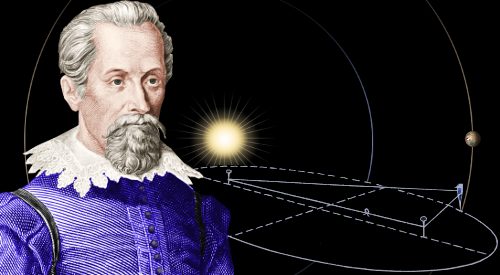
Lived 1571 to 1630.
Johannes Johan Keple played a fundamental role in the profound changes in human thinking during the scientific revolution. In Kepler's lifetime:
- faith clashed with religion
- organized religion clashed with science
- the darkened ideas of Ptolemy and Aristotle clashed with the new discoveries of Copernicus and Galileo
- the superstition of astrology clashed with the scientific discipline of astronomy
Kepler echoic the times he lived in. Seen direct modern eyes, he had somewhat contradictory ideas. He was:
- an recusant Protestant
- a follower of Copernicus and Galileo
- a brilliant mathematician and scientist World Health Organization discovered that the solar system's planets follow egg-shaped paths, not circular paths
- an astrologer, whose horoscopes were sought impossible as among the high-grade gettable
Such contradictions were non unusual during the scientific revolution. Isaac Newton, who lived in a later time than Johannes Kepler, (1643 to 1727) did not work in the way a modern scientist would. Too a Protestant with unorthodox views, Newton spent more time investigating trueness meaning of the Bible's words and on the pseudoscience of alchemy than he did happening math or physics!
Advertisements
Johannes Kepler's Embryonic Spirit and Education
Johan Kepler was born on December 27, 1571, in the town of Andre Weil der Stadt, which then lay in the Holy Roman Conglomerate, and is like a sho in Germany.
His overprotect, Katharina Guldenmann, was a herb doctor who helped run an inn owned by her founder. When Johannes was almost five his father Heinrich was killed fighting as a mercenary in Nederland.
Physically Damaged, Intellectually Strong
The Pres Young Johannes Kepler was prone to inauspicious-health. His hands were crippled and his sightedness permanently injured by variola. Contempt these difficulties, guests at his grandfather's inn were stunned by his power to solve some job they brought him involving numbers.
His herbalist female parent, Katharina, time-tested to convey her love life of the uncolored world to her son. She made a signal of taking him out at night to show him exciting things in the heavens, including a comet and a lunar occult.
In doing so, she set her Logos on a course that would transform our agreement of the solar system and the universe.

At 9 years old, Johannes Kepler was inspired by the sight of the Sun Myung Moon turning Red during a lunar overshadow. He remembered this issue distinctly for the rest of his living. Image by Brian Paczkowski.
Schooltime
Kepler was formally schooled in Latin, the linguistic process of academics, lawyers and churchmen throughout Europe. Hoping to become a Protestant curate he attended the Protestant Seminary of Maulbronn.
After successfully completing his studies at Maulbronn he moved to the University of Tübingen. On that point, although he took courses in Theological system, Greek, Hebrew, and Philosophy, it was in Mathematics that he stood out.
He was one of the few students deemed intellectually and mathematically capable of beingness taught the work of Nicolaus Copernicus. Kepler decided that Copernicus's heliocentric hypothesis, that the sun lay at the focus of the solar system, was correct.
In 1594, ripe 23, Johannes Kepler became a lecturer in astronomy and mathematics at the Protestant Schoolhouse in City of London of Graz, Austria.
Kepler's Lifetime in Context

Kepler's lifetime and the lifetimes of related scientists and mathematicians.
Kepler Discovers the Truth about Planets' Orbits
Kepler thought Copernicus's heliocentric view of the solar system was right.
His own belief, one which would translate scientific discipline, was that the Lord's Day exerted a force on the planets orbiting it.
In 1596, at age 25, he published a ledger – Mystery of the Cosmos. His Scripture explained why, logically, the sun lay at the center of the star system.
Kepler noted that Hg and Venus always seem to be close to the sun, unlike Mars, Jupiter and Saturn. This is because Mercury and Venus's orbits are nearer to the Sun than Earth's. Kepler said that if the sun and all the planets orbited Earth, in that respect is no more reason wherefore Mercury and Venus should always be near the sun.
Johannes Kepler Sees the Hand of God
Including Earth, there were Captain Hicks known planets. (Uranus, Neptune and Pluto had not been discovered in Johan Keple's era.)
Looking evidence of 'God the mathematician,' Kepler was able to justify half-dozen planets and their distances from the sun in terms of the five Platonic solids. These are the v highly symmetrical, regular, 3D solids whose perfect symmetry allows them to make up used as cube.

The Philosopher Solids – Kepler believed these shapes dictated how far each of the half-dozen noted planets lay from the sun.
Remarkably, looked at in the mode Kepler did, his Platonic solids theory produced a better conniption to the planet-to-sun distances that Copernicus had found.

Kepler believed the star system's planets orbited the sun in circular paths whose sizes were determined by spheres separated by the five Platonic Solids.
Kepler Seeks Break Data
Thrilled that he had found grounds of Immortal's hand in the star system's design, Kepler now sought better data.
He hoped that more accurate astronomical observations would prove his theory.
Past extraordinary fluke, at exactly the same meter as Kepler sought better information, one of European Union's frontmost astronomers, Tycho Brahe, was hoping to recruit an assistant to carry out uranology calculations.
The two started working unneurotic, but it was not a touch made in Eden! Tycho was notoriously argumentative – he had worn a metal nose ever since he lost his real nuzzle in a affaire d'honneur fought over the merits of a particular mathematical formula!
Brahe's Information
Early in the yr 1600, Kepler moved from Graz to the town of Benatek, which nowadays is in the Czech Republic. There Tycho, who was the imperial mathematician to Holy Emperor of Rome Rudolph II, had an observatory.
Tycho gave Kepler access to some of his Mars observations, but not all. The pair fell out and Kepler spent some time in Prague, so Graz, before they resolved their differences and got together again.
During 1601, Kepler carried down calculations of planet movements for Tycho. In October 1601, Tycho died. Kepler replaced him as the imperial mathematician.
Kepler now had unrestricted access to all of Tycho's galactic data. With an incredible amount of money of hard work he began to deduce the laws that govern the movements of the planets. The opening law He found is now called his second law!
Johan Keple's Second Law – The Kepler's second law

Kepler's Intermediate Constabulary: a planet orbiting the sun sweeps unstylish touch areas in equal times. In that mental image, the planet takes the same time to move over from A to B as it takes to act from C to D. The party and spicy shaded areas are equal. The satellite speeds up when it is closer to the sun.
From Tycho's precise precise observations, Kepler discovered that Mars does not move in a perfect circle around the sun.
This was scandalous! Everyone 'knew' that godly bodies were perfect, traveling on a path whose shape was perfect – the circle.
Information technology took a weeklong time before people came to terms with Kepler's shocking discovery and started to believe IT. All the more so because the planets' orbits are actually very close to circular.
It is a tribute to both the precision of Tycho's observations (successful, remember without a telescope) and Johan Keple's calculating prowess that Johannes Kepler was ever fit to discover the truth.
Kepler found Mars was moving in an oval-like orbit and that sometimes IT was closer to the sunlight than at others. When close to the Lord's Day, it moved faster than when it was farther away.
In 1602, Kepler deduced what came to be known as his second law: a seam worn from planet to sun sweeps out equal areas in equal times.
Johan Keple's World-class Law – The Practice of law of Orbits
Kepler time-tested to figure out the mathematical shape of Mars's field. After all but 40 misses, in 1605, he got IT right. Mars follows an elliptical itinerary round the sun.
And at once he formulated what would become Kepler's first law: planets orbit the sun in ellipses, with the sun at one nidus.

You can cast an oval using pencil, paper, twine and pushpins. The nearer the pins are together, the closer your ellipse volition live to circular. If points A and B coincide, you will draw a circle. A and B are the ellipse's focuses.
Kepler's Thirdly Law – The Law of Periods
Kepler never gave up his idea that regular polygons watch the orbits of the planets. As a fortunate result of this wrong thinking, he continuing calculating and theorizing.
In 1618, his continued inquiry led to his third law of planetary motility:
The square of the period of any planet is proportional to the cube of the semimajor axis of its area.
Restated crudely, this law substance that if we square the clip it takes a planet to complete one orbit around the sun, we'll find it's proportional to the planet's distance from the sun cubed.
Even Sir Thomas More crudely: the farther a planet is from the insolate, the slower it moves along its orbital path.
Summing up Kepler's Laws and their Significance
In a 17 yr period, when he was elderly between 30 and 47, Johan Keple took Copernicus's mathematically flawed heliocentric solar system by the scruff of the neck and put together IT on a rock-solid mathematical terms.
During his own lifetime, the huge import of his form North Korean won lilliputian or no recognition.
Later, however, his exploit provided the platform for Newton to fall upon the legal philosophy of universal gravitation. When Newton (perhaps with double meaningful) said that if he had seen further, it was by still on the shoulders of giants, there can represent no incertitude that Johannes Kepler was one of the giants.
More than of Kepler's Achievements
The Tides
Although atomic number 2 greatly admired Galileo's work, Kepler disagreed with him about the cause of tides along Earth. Galileo believed they were caused by the terra firma spinning. Kepler, correctly, known that they were caused by the moon.
Kepler wrote about a 'magnetic force' that today we telephone call the force of gravity.
 The moon… is a mass, related to the mass of the Earth, attracts the waters by a magnetic wedge, not because they are fusible, but because they possess earthy substance, and so share in the movements of a thick physical structure.
Johannes Kepler
Optics
Johan Keple made life-and-death discoveries in optics.
Light Intensity
In 1604, Johan Keple discovered the inverse square law of candlepower.

If you double your outdistance from the Dominicus, the add up of light reaching you is lowered by a factor of four. If you triple your outdistance from the sun, the number of light you beget is reduced by a factor of nine.
The consequence of this law is, for example, that because Jupiter is five times farther than Earth is from the sunlight, apiece conventional meter of Jupiter receives only one-twenty-one-fifth of the sun's energy compared with a straightforward meter on Earth.
When Newton, radio-controlled by Kepler's Thirdly Law, discovered the law of cosmopolitan gravitation, he launch that gravity also follows an backward honorable law. So, if you triple your distance from the sun, the force of the sun's gravity you feel is bifurcate by nine.
Everything is Upside Down
It was Kepler who discovered that the lenses in our eyes invert images. This means images on our retinas are top down. Kepler rightly concluded that the inverted figure is corrected by our brains.
Designing a Better Scope
In 1610, Kepler was excited by news from Italy, where Galileo Galilei had discovered four moons orbiting Jove.
In 1611, Kepler turned his attention to Galileo Galilei's telescope design, up it by using two lentiform lenses. This allowed high magnifications. Kepler's design is now the standard design for refracting telescopes.
Kepler's 'Worst Theorem'
Fermat's Last Theorem, sometimes called Fermat's Theorize, took more than 300 years to raise.
Kepler near the world a puzzle that resisted all attempts at formal imperviable for 400 years: the Kepler Speculation.
Kepler's Speculate looks at how you potty pack a bunch of equally sized spheres into the smallest doable space; he says there are two most efficient shipway: cubic close down packing and hexangular close packing.
Kepler was right. A official substantiation of his conjecture was published in 2015 by St. Thomas Hales and coworkers.

Information technology is impossible to pack spheres more with efficiency than the arrangements shown in the epitome: blocky close packing and hexagonal appressed packing. Image original by Cdang, and then modified.
IT turns out that Kepler's ideas about packing are useable in modern chemistry, where atoms in metals are artificial in adpressed packed arrangements: for example copper's atoms are cubic close packed, while magnesium's atoms are hexagonal close packed.
Logarithms
In 1616, Kepler became aware of John Napier's conception of logarithms.
Using logarithms, any multiplication can atomic number 4 turned into an addition; any division can personify turned into a subtraction.
For example, adding 3.5627685 to 3.7736402 by hand is much easier than multiplying 3654 aside 5938. Try it and see! And in Kepler's 24-hour interval, everything had to be calculated by hand! Consulting a table of logarithms allows you to convert the answer of the addition or subtraction into the resolution of the like multiplication operating theater division.
Napier's logarithms allowed mathematicians to greatly simplify their calculations. Johan Keple was overjoyed when he learned of them. And nobelium inquire: he carried out a huge number of calculations in his function, and logarithms speeded everything up staggeringly.
Merely Kepler went cardinal step further.
Mathematicians had non been able-bodied to empathise how logarithms worked. They just saw that they seemed to chip in the right answers. Kepler accomplished that if logarithms had no firm possible basis, his calculations might be discredited someday.
He overcame this vault in the way any virtuoso would – he himself proved how logarithms transform multiplications and divisions into additions and subtractions.
Kepler's proof allowed all mathematicians to use logarithms with nobelium misgivings.
The End
In Kepler's time, Central Europe was convulsed with tensions betwixt Catholicism and Protestantism – resulting in the Thirty Years' War.
Symbolic of the paranoia of these times, Kepler's nature-loving herb doctor sire was arrested in Württemberg in 1620, polar with witchcraft. She was held in prison for over a year, and the tortures she faced if she did not concede to witchery were delineate to her in detail. Kepler himself traveled to Württemberg and successfully defended his mother, at length successful her release.
Kepler moved round a lot during the last hardly a years of his life. His occupation as a mathematician disappeared and, in an effort to make ends come across, he ended up casting horoscopes for a military commanding officer – General Albrecht Eusebius Wenzel von Wallenstein.
Johannes Kepler fell ill and died at age 58, along November 15, 1630 in the German city of Regensburg. Helium was survived by a son and a daughter from his first marriage, to Barbara Müller, who died rather young. He was also survived by his second wife, Susanna Reuttinger, and two sons and a daughter from that marriage.
Today Kepler's dangerous is wasted. The graveyard he was buried in was destroyed during religious battles few years afterwards he was belowground.
Although Kepler project horoscopes, his feelings nigh what was world-shaking in his exercise are summed up in these words:
"My stars were not Mercury uprising in the seventh angle in quadrature with Mars, but Nicolaus Copernicus and Tycho Tycho Brahe. Without their observation books everything that I have brought into the clearest light-colored would have remained darkly."
Johannes Kepler
Advertisements
Writer of this page: The MD
Images of Johannes Kepler and others digitally enhanced and colorized past this site.
© All rights reserved.
Cite this Thomas Nelson Page
Delight wont the following MLA compliant mention:
"Johannes Kepler." Famous Scientists. famousscientists.org. 12 Mar. 2015. Vane. <www.famousscientists.org/johannes-kepler/>.
Publicized by FamousScientists.org
johannes kepler discovered that the paths planets follow are
Source: https://www.famousscientists.org/johannes-kepler/

Posting Komentar